
How to Choose the Right Boat Lift for Your Dock: A Complete Buyer’s Guide
Buying your first boat is exciting. Buying your first boat lift? Confusing. There are at least four different categories of boat lift on the market, half a dozen brand names everyone keeps mentioning, and most online buyer’s guides assume you already know the difference between a vertical lift and a cantilever. Add in the variables of water depth, boat weight, dock configuration, and budget, and it’s easy to spend hours researching without feeling any closer to a decision.
At Dock Stop, we install boat lifts across Alberta and Western Canada. This guide cuts through the jargon and lays out the four main types of boat lift, when each one makes sense, and the questions to ask before you buy.
Why Do You Need a Boat Lift at All?
A boat lift raises your boat out of the water when you’re not using it. That single feature delivers a long list of benefits: protection from hull damage (no more bumping the dock in rough water), no more algae or mineral buildup on the hull, easier access for cleaning and maintenance, faster launch and retrieval, and dramatically longer boat life. For most boat owners, a lift pays for itself in preserved hull value within 3–5 years.
The 4 Main Types of Boat Lift
-
Vertical Boat Lifts
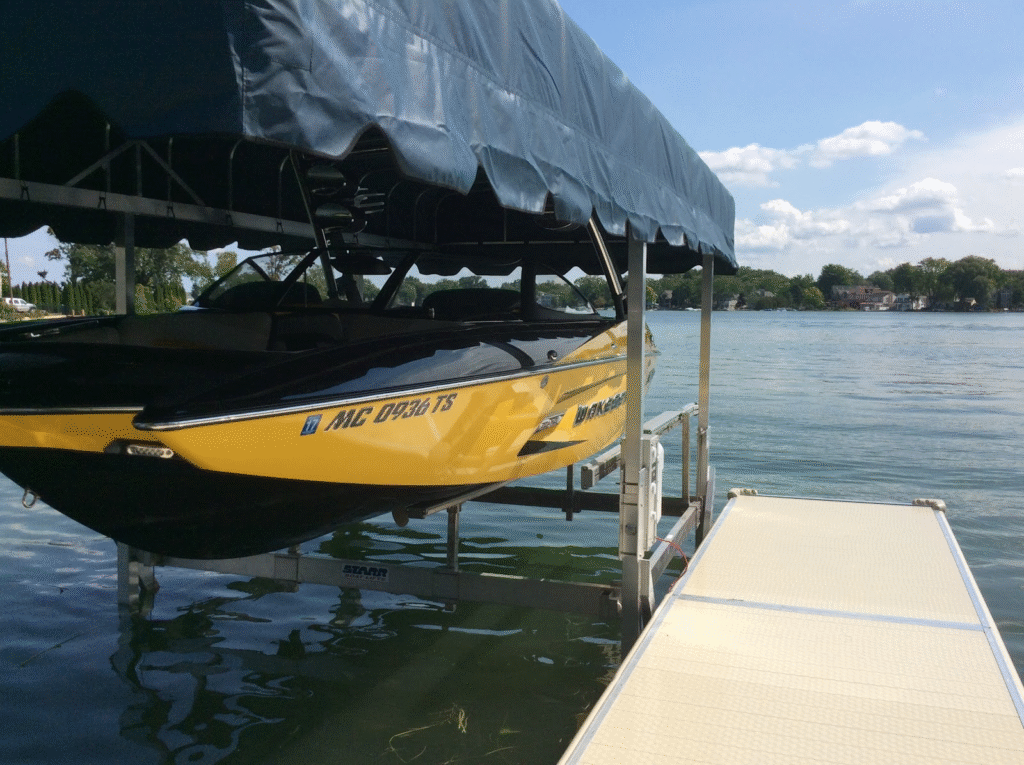
Vertical lifts raise and lower your boat straight up and down using cables and pulleys. They’re the most common type for permanent docks in moderate water depth (4–8 feet typical). Best for: stable water levels, larger boats, permanent dock setups. Not ideal for: shallow water or sloped lake beds.
-
Cantilever Boat Lifts
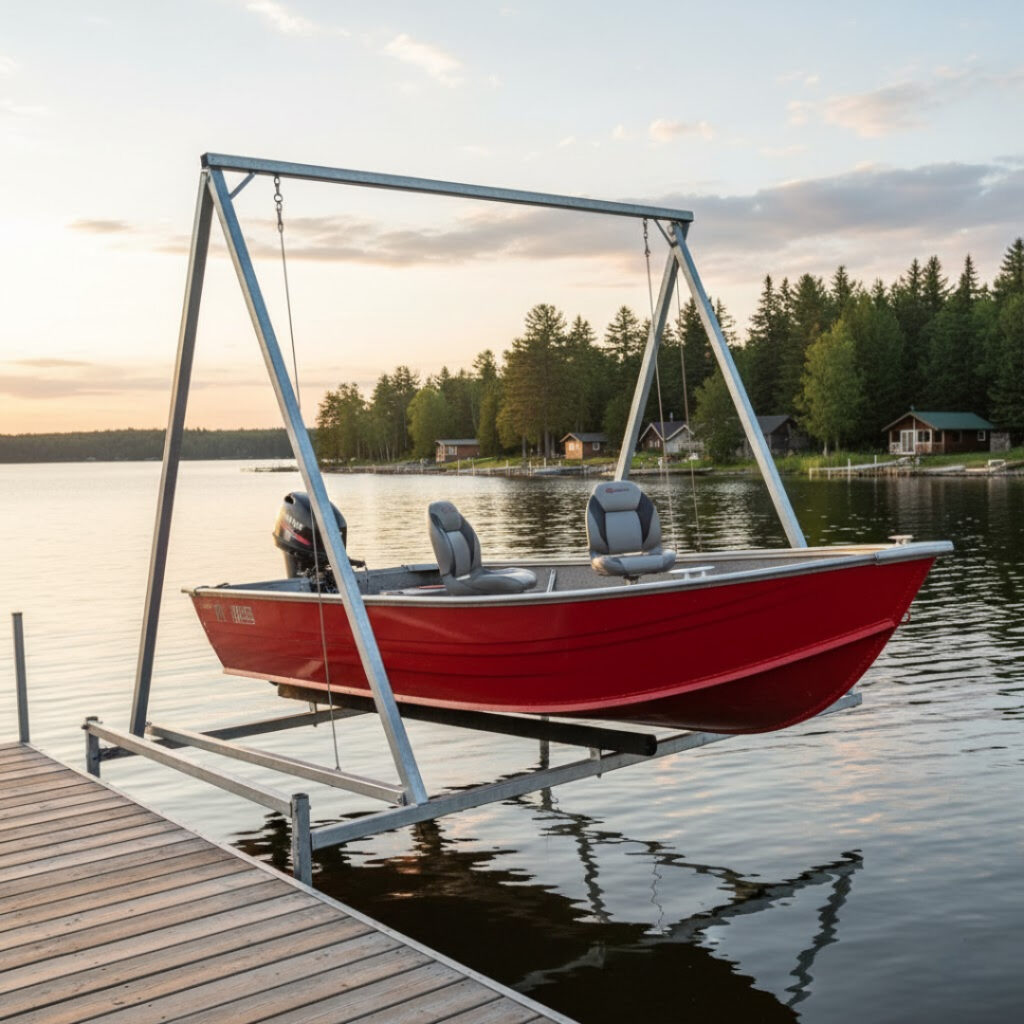
Cantilever lifts use a pivoting arm mechanism — when you crank the handle, the lift cradle swings up and back, lifting your boat out of the water. Best for: shallow water (under 4 feet), smaller boats, lakes with fluctuating levels. Often a more affordable option than vertical lifts.
-
Floating Boat Lifts
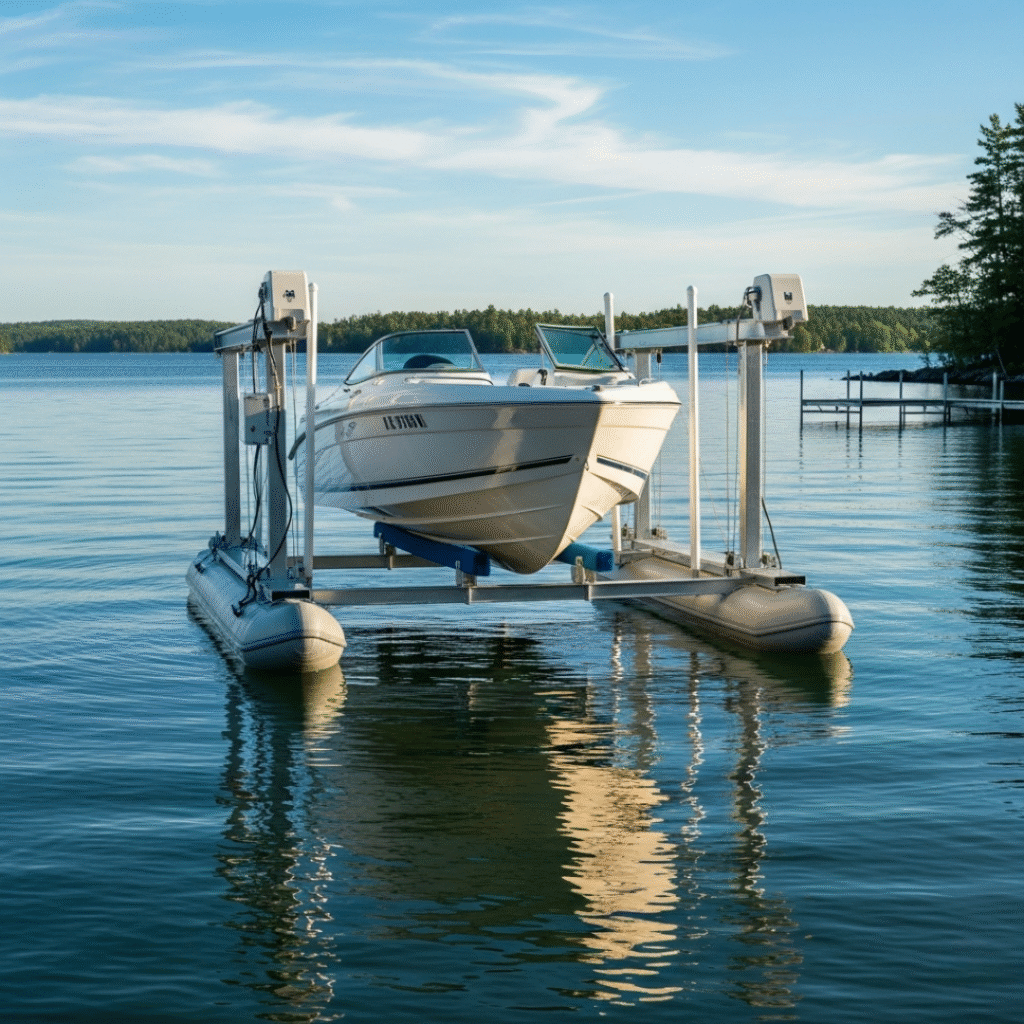
Floating lifts use sealed air chambers (or polyethylene drums) to raise and lower the boat without any mechanical winching — you flood or drain the chambers to control the position. Best for: deep water (8+ feet), fluctuating water levels, locations where a permanent ground-anchored lift isn’t practical. Increasingly popular and a key strength of our product mix at Dock Stop.
-
PWC (Personal Watercraft) Lifts
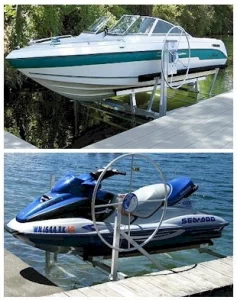
Smaller-capacity lifts designed specifically for Sea-Doos, Jet Skis, and other personal watercraft. Usually free-floating or simple cantilever designs in the 1,000–1,500 lb range. Best for: anyone who owns one or more PWCs — protects the hull, makes launching dramatically easier, and stores the craft above water when not in use.
5 Questions to Ask Before You Buy a Boat Lift
- How much does my boat weigh fully loaded? Add 15–20% to the dry weight to account for fuel, gear, and water on the hull. Lift capacity must exceed this number — never undersize.
- What’s the water depth at the dock at high and low water levels? This dictates the lift type. Shallow water (under 4 ft) → cantilever. Moderate (4–8 ft) → vertical. Deep (8+ ft) → floating.
- Does the lake level fluctuate significantly through the season? If yes (common in Alberta reservoirs), a floating lift is usually the right call — it self-adjusts.
- What’s the lake bottom like — sand, rock, or muck? Solid bottoms favour anchored lifts; soft muck favours floating designs with screw anchors.
- How often do I want to operate the lift? Manual lifts are cheaper but slower. Electric and hydraulic options speed up daily use, particularly for larger boats.
Brand Names You’ll Hear About
Hewitt, ShoreStation, Daves Docks, Western Boat Lift — there’s a strong lineup of established names in the Canadian boat lift market. At Dock Stop, we focus on matching the right product to the actual conditions at your dock, regardless of brand. The “best” boat lift is always the one that fits your boat, your water, and your usage — not the one with the biggest marketing budget.
Should You DIY a Boat Lift?
We get this question every season. Yes, you can technically build your own boat lift — and many lake-property owners do. But the failure modes (a partially submerged boat, a hull punctured by a loose bunk, a snapped cable that drops $30,000 of fibreglass into the water) are expensive enough that most owners decide the cost of a professionally engineered and installed lift is the better long-term math. If you do go the DIY route, at minimum: oversize the capacity by 25%, use marine-grade hardware throughout, and inspect every connection annually.
Frequently Asked Questions
How much does a boat lift cost in Canada?
Entry-level PWC lifts start around $1,500. Mid-size cantilever or vertical lifts for 16–20 ft boats typically run $4,000–$8,000. Floating lifts for larger boats can range $8,000–$20,000+, depending on capacity and features.
How long does a boat lift last?
Properly maintained, 20+ years is normal. Marine-grade aluminum frames and stainless-steel hardware are the keys to longevity, particularly in fluctuating Alberta lake conditions.
What’s a “boat lift helper” and do I need one?
A boat lift helper is an aftermarket accessory that helps crank a manual lift more easily — basically a leverage tool or motor assist. They’re a good upgrade for older manual lifts where cranking has become a chore, or for lifts handling heavier boats.
Can I leave a boat lift in the water over winter?
In Alberta, no. Ice movement can severely damage anchored lifts. Most lifts need to be raised, repositioned, or removed before freeze-up. Floating lifts are often pulled to shore for the winter.
Do I need a permit for a boat lift on my dock?
Depends on the body of water. Most private lakes don’t require one; some provincial waterways do. Check with your local conservation authority before installation.
Ready to Buy or Install a Boat Lift?
Dock Stop installs boat lifts across Alberta and Western Canada. Whether you’re upgrading to a floating system, replacing an aging manual lift, or buying your first PWC lift, our team will match you to the right product for your conditions. Visit dockstop.ca to browse our lineup or contact us for a custom recommendation.