
The Perfect Cradle: A Step-by-Step Guide to Adjusting Boat Lift Bunks
Getting a new boat is an incredible feeling, but before you celebrate with a sunset cruise, there is one technical hurdle you can’t afford to skip: adjusting your boat lift bunks. Think of your boat lift as a custom-tailored suit for your vessel. If the fit is off, it’s not just uncomfortable—it’s structurally dangerous. Improperly positioned bunks can lead to “hull hooks” (permanent bends in the fiberglass), gel coat cracking, or even a catastrophic failure of the lift itself.
In this guide, we’ll walk you through the precise science of cradling your boat correctly to ensure your investment stays high, dry, and damage-free.
Why “Close Enough” Isn’t Good Enough
Many boaters assume that if the boat stays on the lift, the job is done. However, your boat’s hull is not equally strong everywhere. The strongest points of a vessel are the internal stringers (the “ribs” of the boat).
If your bunks are placed too far out toward the thin outer hull, the weight of the engine and fuel can cause the hull to flex or “oil-can.” By adjusting your bunks to sit directly under the stringers, you ensure the boat’s weight is distributed exactly where the engineers intended.
Step 1: The Measurement Phase
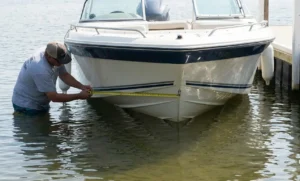
The most common mistake is trying to “eyeball” the adjustment while the boat is hovering over the lift. You need hard numbers.
-
Measure the Stringers: While your boat is on its trailer or in the water, measure the distance from the center keel to the primary lifting strakes or internal stringers.
-
Check the Deadrise: Determine the angle of your hull’s “V.” Most bunk brackets are adjustable, and matching this angle ensures the bunk makes 100% contact with the hull rather than just touching a single edge.
Pro Tip: Don’t forget to measure the distance from the transom to the end of the boat. Your bunks should ideally extend an inch or two past the transom to provide maximum support for the heavy engine area.
Step 2: The Dry Adjustment
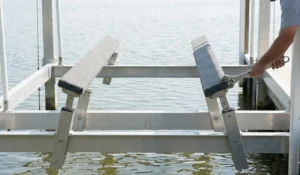
Now that you have your numbers, it’s time to move the hardware. This should always be done with the lift empty and raised to a comfortable working height.
-
Loosen and Slide: Loosen the galvanized or stainless steel bolts on your bunk brackets. Slide them horizontally along the cross-beams to match your stringer measurements.
-
Set the Angle: Tilting the bunk boards to match your hull’s deadrise ensures the boat won’t “rock” when it settles.
-
Torque It Down: Once positioned, tighten the bolts securely. Marine environments involve constant vibration; a loose bolt today is a dropped boat tomorrow.
Step 3: The “Wet Test” Verification
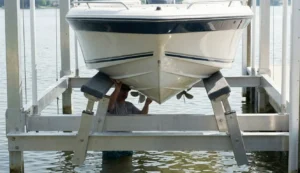
The final step is the most critical. You need to see how the boat actually sits on the cradle.
-
Slow Approach: Drive the boat onto the lift slowly.
-
Partial Lift: Raise the lift until the bunks just barely touch the hull.
-
The Underwater Inspection: This is where you might need to get your feet wet. Inspect the contact points. Is there a gap at the front? Is the boat leaning?
-
Check Clearances: Ensure the propeller, rudder, and tracking fins have at least 3–5 inches of clearance from the lift’s cross-beams.
Common Mistakes When Adjusting Boat Lift Bunks
Avoid these common issues:
-
Supporting the outer hull instead of stringers
-
Setting bunks too narrow or too wide
-
Ignoring hull angle
-
Rushing the process
Small mistakes can lead to expensive damage over time.
How Often Should You Recheck Bunk Adjustments?
You should recheck bunk alignment:
-
When switching boats
-
After lift relocation
-
At the start of each boating season
-
If the lift settles or shifts
Seasonal inspections help maintain proper support and lift performance.
DIY or Professional Adjustment?
Adjusting boat lift bunks can often be a DIY task for smaller boats, but professional help is recommended if:
-
You’re unsure where the stringers are
-
The boat is large or heavy
-
The lift needs repositioning or leveling
Professional setup ensures long-term protection and peace of mind.
When to Call the Professionals
If you’ve recently upgraded from a single-hull boat to a pontoon or tritoon, the adjustment process changes significantly. Pontoons require specialized “cradle” kits or under-deck supports that often involve more complex geometry.
At Dock Stop, we’ve seen it all—from perfectly balanced wake boats to “accidents waiting to happen.” If you aren’t comfortable diving into the water to check your alignment, or if your hardware is rusted shut, our team can help you dial in the perfect fit.
Adjusting your boat lift bunks is the ultimate “measure twice, cut once” task. It may take an afternoon of fine-tuning, but the reward is a boat that stays structurally sound for decades.